
The Three Fundamentals of Politics
Resources. Power. Interests

One of the central tenets of existentialism, forged in the Second World War, was that existence precedes essence. Extrapolated to everything, it means that the world as a material thing simply “exists” and it’s up to the human subject to apply essence or meaning to it. If spiritual thinking is the attempt to escape from the apparently harsh reality of life’s meaninglessness, ideology is a desire to transcend the reality of politics.
Politics rests on three fundamental realities:
Resources. What Marxism calls “the relations of production.” Basically the gathering, use, and control over essential resources.
Power. Who holds the monopoly on physical violence? What latitude do regular people can have with whoever is in charge, whether that’s a state, the most powerful gang, or a local warlord?
Interests. Individuals, families, tribes, communities, institutions, and authorities doing what’s good for them.
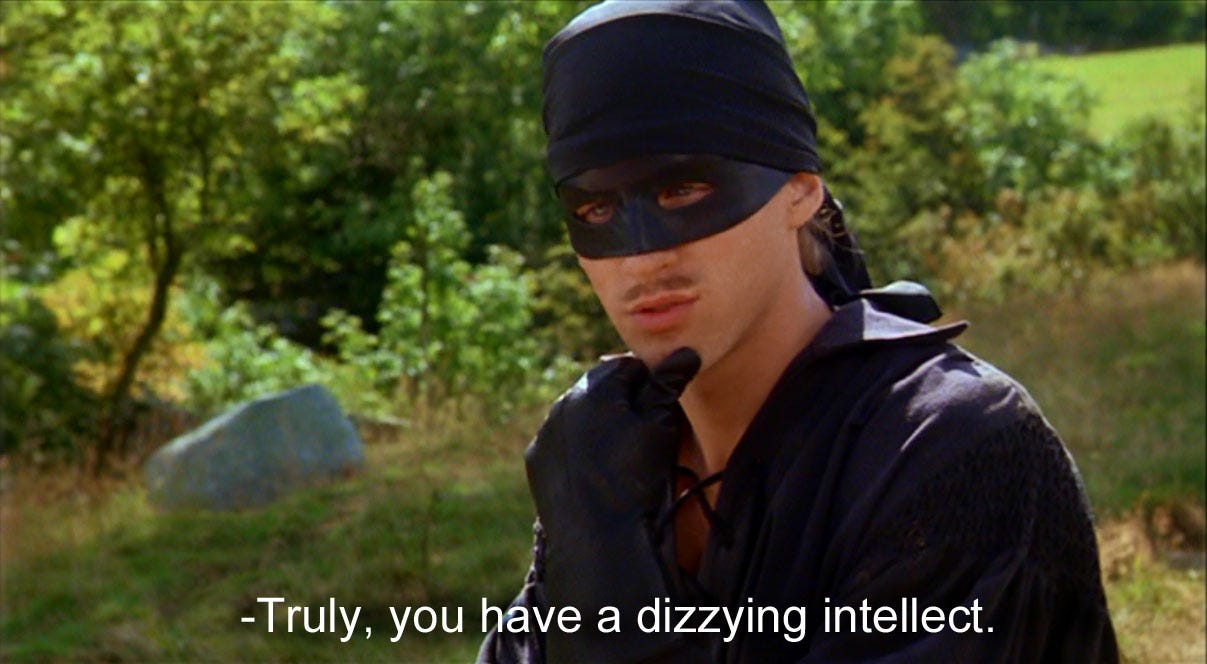
This is all politics is—and to paraphrase the hero of The Princess Bride, anyone who tells you differently is either lying or selling something. It’s little more than the branding, marketing, and advertising messaging that obscures what’s really at play: resources, power, and self-interest.
The ideological layer on top of these realities comprises a marketplace inhabited by two competitors: a very annoying person telling you that “a better world is possible,” and another very annoying person preaching that “we’ve lost our way.” Want to know what they’re really after? Look no further than leaders of the Black Lives Matter movement cashing in to buy expensive new homes or police abolitionists going on $75,000 spending sprees. Or just look at the entirety of the “prosperity gospel.”
To place ideology within the Judeo-Christian paradigm: leftism is the yearning for the theoretical promised land of Exodus, whereas its right-wing variant forever mourns its own lost Eden of Genesis. Leftism represents the line of thinking that reality and nature can be transcended through political action to bring about emancipation, liberation, and transcendence. Right-wing ideology represents an allegiance to the prevailing power relations and moral attitudes of a certain period of time—usually the adherent’s adolescence, the year of their birth, or a fantastical imagining of the distant past.
To keep people within their respective worlds, each ideology must become more and more absurd whenever the reality of politics begins to break the spell. For the reactionary or conservative—when faced with the contradictions and complexities of their own halcyon days—the absurdity manifests in baffling distortions about the ancient world, the early modern era, or the middle ages grafted onto our own time. Whereas the leftist—bludgeoned by the manifest unworkability of their utopian schemes—reaches for ever-more insane and childlike pronouncements about how violently destroying people’s livelihoods is actually good or how a basic reality (e.g., gravity) is a “just a social construct.”
This is an edited excerpt from a longer article, “The Consolation of Nonsense,” published in Splice Today on December 4, 2024.